Sunscreen gets the most attention in sun care and for good reason. But protecting your skin from UV rays is only half of the picture.
Every time your skin is exposed to the sun, it loses moisture and undergoes stress at a cellular level, whether or not a sunburn is visible.
The steps you take after sun exposure are also important to your overall skin health. That is where aftersun comes in. Here is everything you need to know.
What Is Aftersun?
Aftersun is a skincare product formulated to soothe, hydrate, and support skin recovery after UV exposure. It is not a replacement for sunscreen and offers no sun protection.
What it does is address the specific state that sun-exposed skin is left in after a day outdoors: depleted of moisture, temporarily inflamed, and in need of replenishment.
Available in lotion, gel, and spray formats, it is typically applied once you are out of direct sunlight for the day.
Apply to all areas that have been exposed to the sun, on both the face and body. It is suitable for everyday sun exposure, not just for occasions when the skin has visibly burned.
What Does UV Exposure Do to Your Skin?
To understand why aftersun matters, it helps to understand what sun exposure does to the skin in the first place.
UV rays temporarily disrupt the skin’s barrier function, which increases trans-epidermal water loss, the rate at which moisture evaporates through the outermost layer of the skin. Think of the skin barrier like cling film over a bowl of water.
When it is intact, moisture stays in. When UV exposure weakens it, that protective layer becomes less effective and moisture escapes far more quickly than usual.
British Association of Dermatologists, confirms that transepidermal water loss is a reliable objective measure of skin barrier integrity, and that any disruption to the barrier leads directly to increased moisture loss.
Source: British Association of Dermatologists, 2022
Sun-Exposed Skin
This is why skin often feels tight, dry, or uncomfortable hours after sun exposure, even when it does not look burnt. The barrier has been disrupted and moisture is leaving the skin faster than it can be replaced.
UV exposure also triggers an inflammatory response in the skin. The redness, heat, and sensitivity you feel after a day outdoors are the visible signs of this process at work, even at low levels of exposure.
Free radicals generated by UV rays continue to cause oxidative stress to skin cells after you leave the sun, not just during exposure itself.
Over time, repeated sun exposure without adequate aftercare contributes to visible changes in the skin including dryness, uneven texture, pigmentation, and a gradual loss of elasticity.
These effects begin at a cellular level with each exposure, which is why consistent post-sun care matters beyond just managing sunburn. For more on how UVA and UVB rays affect the skin, our guide covers the full picture.
What Does Aftersun Actually Do?
A well-formulated aftersun addresses each of these effects through its key ingredients. Here is what to look for and why each one matters:
Hydrates the Skin
Sun exposure and heat cause loss of moisture. Hyaluronic Acid, a naturally occurring molecule already present in the skin and acts like a sponge for moisture, attracts and retains water at the skin’s surface.
Research confirms that just one gram of Hyaluronic Acid is capable of binding up to six litres of water, making it one of the most effective hydrating ingredients available.
It helps plump the skin and restore hydration levels depleted by a day in the sun, leaving skin feeling replenished rather than tight or dry.
Source: PMC, 2009
Soothes Redness and Irritation
Aloe Vera is a succulent plant and Aloe Vera gel is one of the most well-evidenced soothing ingredients in skincare.
Its anti-inflammatory properties make it particularly effective for calming skin after UV exposure.
It works to calm the skin, reduce redness, and replenish the skin’s surface. The result is skin that feels settled rather than stressed.
Source: Skin Pharmacology and Physiology, 2008.
Nourishes and Softens
Shea Butter is a natural fat extracted from the nut of the African shea tree. Rich in essential fatty acids including oleic and stearic acid, it works by interacting with the skin’s own lipids to strengthen the barrier and lock in moisture.
Open Journal of Chemistry found that shea butter reduced trans-epidermal water loss by 37.8% and increased skin hydration by 58% within 24 hours of application.
In plain terms, it measurably reduced the rate at which skin loses moisture and increased how hydrated the skin felt, both of which are particularly valuable after a day in the sun when the skin barrier has been temporarily disrupted by UV exposure.
Source: Open Journal of Chemistry, 2025.
Cools on Contact
Not all aftersun formulas cool the skin, but those that do provide immediate relief to skin that feels warm, tight, or sun-stressed.
The cooling sensation comes from the evaporation of lightweight ingredients as the formula is applied and absorbed, which draws heat away from the skin’s surface in the same way that stepping into the shade feels instantly cooler than standing in direct sun.
This immediate cooling effect is particularly valuable in the first moments after sun exposure, when the skin’s inflammatory response is at its most active.
Reducing surface temperature quickly helps calm the skin before the hydrating and soothing ingredients begin their longer-term work.
For best results, apply aftersun to clean, dry skin. Applying to slightly warm skin after a shower, rather than very hot or very cold skin, allows for the most effective absorption of the formula’s active ingredients.
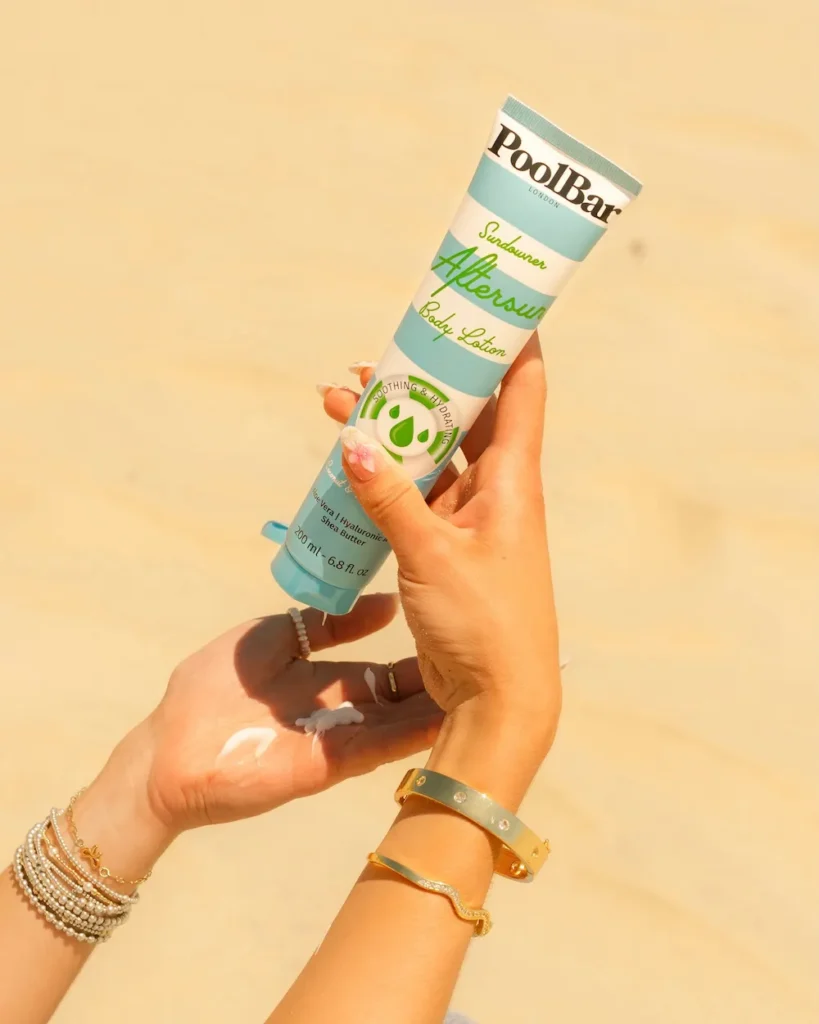
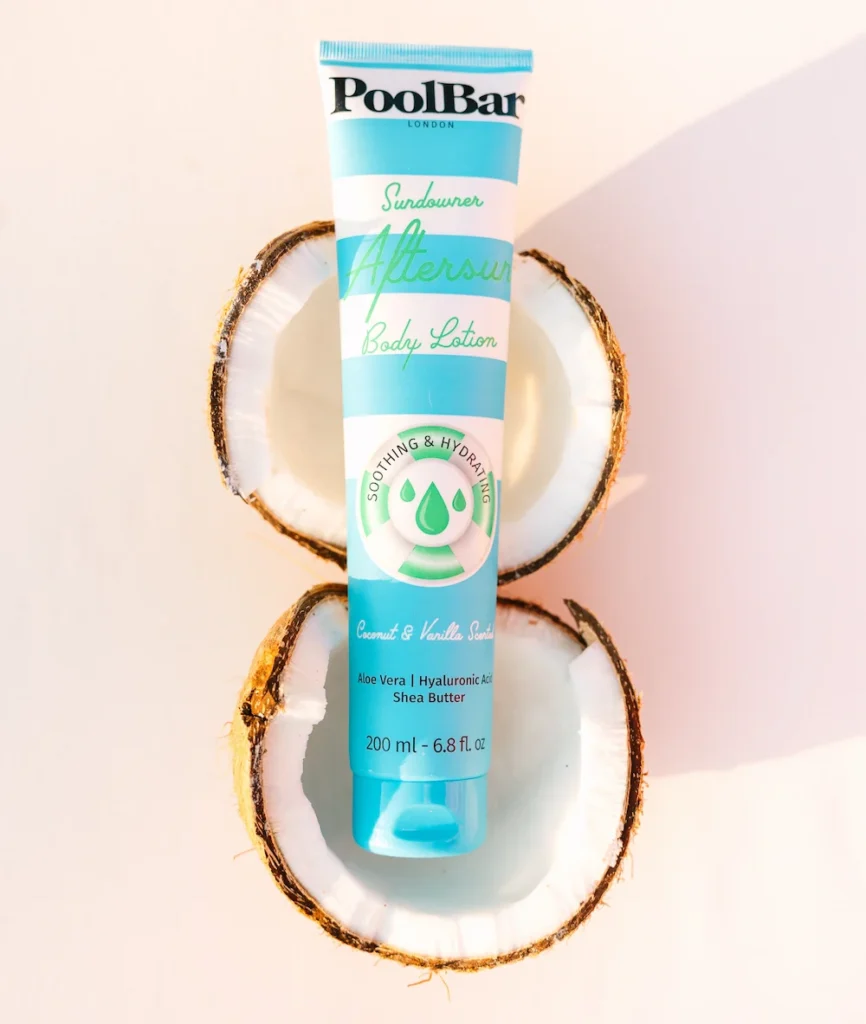
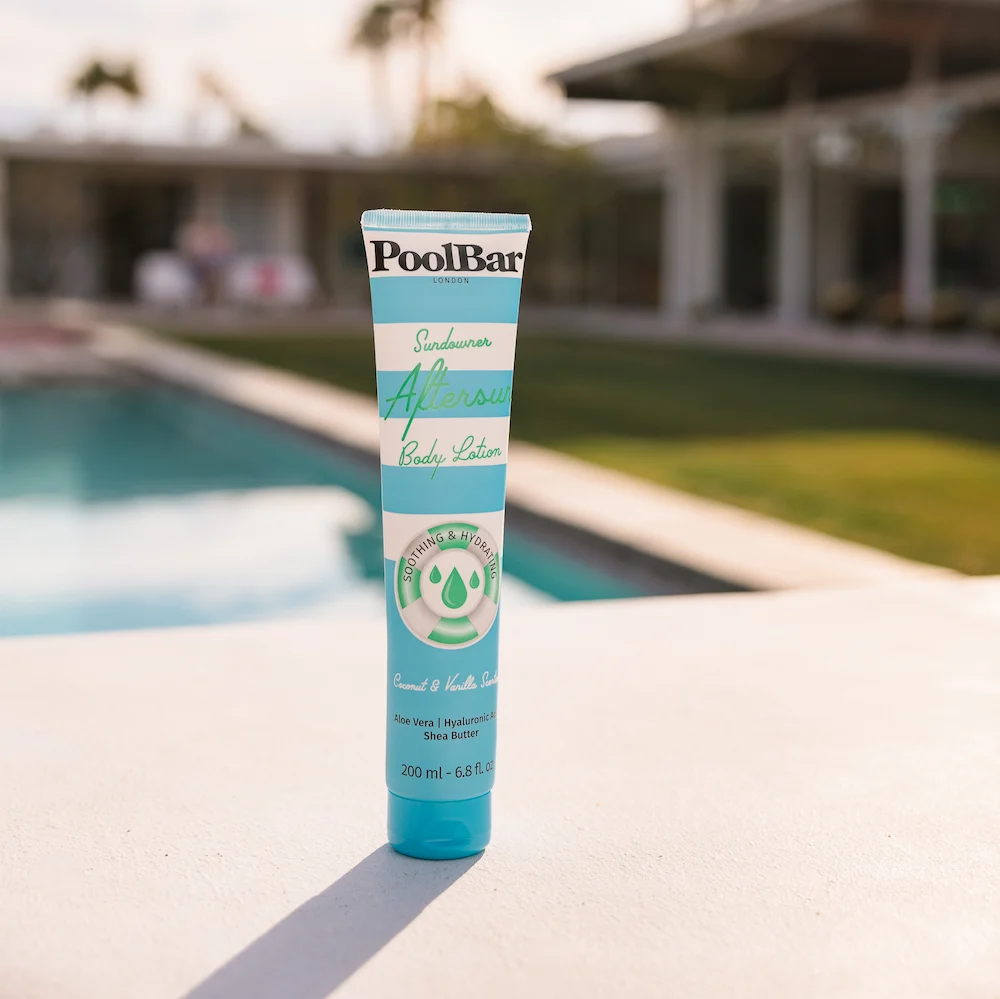
PoolBar’s Sundowner Aftersun contains all three ingredients in a non-sticky and cooling formula, suitable for all skin types.
Quick Aftersun Reference Guide
| Ingredient | What It Does |
|---|---|
| Hyaluronic Acid | Attracts and retains moisture at the skin’s surface, helping to plump and rehydrate skin depleted by sun exposure. |
| Aloe Vera | Calms redness and soothes UV-induced skin irritation through well-documented anti-inflammatory properties. |
| Shea Butter | Strengthens the skin barrier, locks in moisture and nourishes skin back to feeling soft. |
| Cooling Agents | Draw heat away from the skin’s surface on contact, providing immediate relief to warm or sun-stressed skin. |
Is Aftersun the Same as a Regular Moisturizer?
This is one of the most common questions around aftersun and the honest answer is no.
Both aftersun and regular body moisturizers hydrate the skin, but they are formulated with different purposes in mind. A standard body lotion is designed for general daily hydration.
Aftersun is formulated specifically for the post-UV skin, with higher concentrations of soothing and anti-inflammatory ingredients that address redness, barrier disruption, and rapid moisture loss.
Using a regular moisturizer after sun exposure is better than using nothing. But it does not replicate the targeted soothing and recovery function of a dedicated aftersun formula.
In the same way that a glass of water and an electrolyte drink after a workout both hydrate you, but electrolytes are designed with muscle recovery in mind.
When Should You Apply Aftersun?
Apply aftersun as soon as possible after sun exposure, ideally once you are out of direct sunlight for the day.
For best results, apply to clean, dry skin. Showering before application allows the skin to be clean and slightly warm, which aids absorption.
Apply to all areas that have been exposed to the sun, not just areas that feel burned or tight. Sun stress affects all exposed skin, not only the parts that look red.
How Often Should You Apply Aftersun When Burnt?
For sunburn, more frequent application is recommended. Reapply whenever the skin feels hot, tight, or dry, and immediately after swimming, sweating, or towel drying.
Consistent reapplication is more important than a single generous application. A cool compress or cool water on the affected area before applying aftersun can provide additional relief.
If sunburn is severe, blistering, or accompanied by fever, chills, or dizziness, seek medical advice immediately, rather than relying on aftersun alone.
Can You Use Aftersun Even Without A Sunburn?
Yes, aftersun is not a product reserved for sunburn. Any sun exposure, even without visible redness, causes some level of skin stress and moisture loss.
Using aftersun consistently after everyday sun exposure supports long-term skin health in the same way that wearing sunscreen before going outside does.
Think of it as the final step in a complete sun care routine: mineral sunscreen applied correctly before and during exposure, aftersun applied after.
For more on building a routine from start to finish, our skincare routine guide covers how each step fits together.
It also means that if you spend time outdoors regularly, whether commuting, exercising, or simply being outside, aftersun earns its place in your daily routine year-round, not just on holiday.
For more on when UV rays are at their strongest and why protection matters beyond the summer months, read our guide.
Sun Care Infused With Skincare
PoolBar’s Sundowner Aftersun is formulated with Hyaluronic Acid to hydrate and plump, Aloe Vera to soothe and calm, and Shea Butter to nourish and soften.
Dermatologically tested and cruelty-free, with a signature coconut and vanilla scent. The final step your skin deserves after a day in the sun.