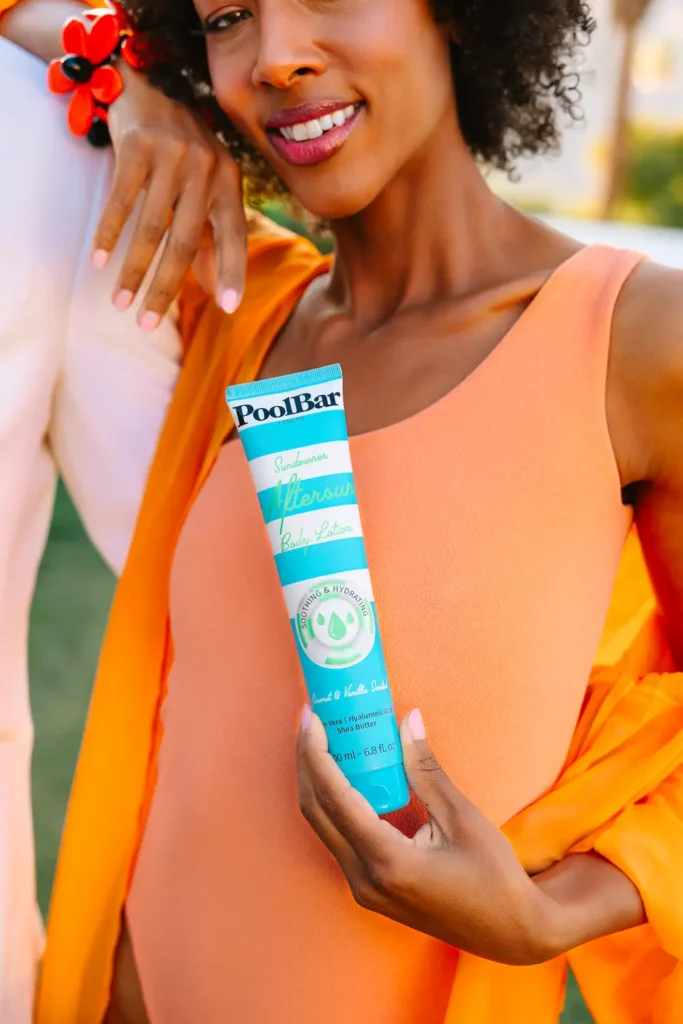
The SPF spray vs lotion debate is worth having, but only if your sunscreen already provides the basics.
No matter what type of sunscreen you choose, make sure it offers broad-spectrum protection, carries an appropriate sun protection factor, and that you apply it correctly and consistently.
Once you have a sunscreen that ticks those boxes, the question comes down to one thing: your routine. Here is everything you need to know.
How Does Sunscreen Protect The Skin?
Sunscreen works by applying UV-filtering active ingredients across the skin to reduce UV radiation reaching the skin’s surface. Whether you’re protected by a lotion you rub in or SPF you spray on, the chemistry behind the products are the same.
What differs is how the product gets onto your skin, and how easy it is to apply it correctly. The active ingredients are what do the work. Mineral sunscreens use Zinc Oxide or Titanium Dioxide to reflect and scatter UV rays.
Chemical sunscreens use organic filters such as avobenzone or octinoxate to absorb UV energy and convert it into heat. They are widely available in both a cream and spray formula. If you want a deeper dive into mineral vs chemical sunscreen, you can read more here.
What determines your protection from the sun is the SPF level, whether the product offers broad-spectrum coverage against both UVA and UVB rays, and how thoroughly and consistently you apply it. A broad-spectrum label matters because UVA and UVB rays affect the skin differently.
UVA rays penetrate deeper into the skin and are linked to premature ageing and long-term damage. UVB rays are responsible for sunburn.
Not every sunscreen protects against both, which is why checking for broad-spectrum on the label is the first step. For a full breakdown of how UVA and UVB rays differ, our dedicated guide covers everything you need to know.
What Is Sunscreen Lotion?
Sunscreen lotion is a topical cream or liquid sun protection product applied directly to the skin by hand.
It contains UV-filtering active ingredients designed to reduce the amount of UV radiation reaching the skin and is available in both mineral and chemical formulas across a range of SPF levels and textures.
Sunscreen lotion is generally considered a popular choice for the first application of the day, to ensure even coverage before sun exposure begins.
Coverage and Visibility
The most practical advantage of lotion is that you can feel exactly where you have applied it, as you rub the sunscreen in. This makes it easier to ensure full, even coverage without missing areas. That reassurance matters more than most people realise.
Research published in the National Library of Medicine found that people apply roughly 20-50% of the recommended amount of sunscreen.
Source: Canadian Dermatology Association, 2020
To make sure you are applying enough mineral sunscreen, a simple guide to follow:
- 1 teaspoon for the face and neck
- 1 teaspoon for each arm
- 1 teaspoon for the front torso
- 1 teaspoon for the back torso
- 2 teaspoons for each leg
Apply in sections and dot small amounts across the area, gently massage and blend until absorbed, then repeat until the full amount has been applied. Working section by section makes it far easier to track coverage and avoid missed patches.
Reapply every two hours and immediately after swimming, towel drying, or excessive sweating.
For a full step-by-step guide to applying sunscreen correctly, our application guide covers everything you need.
Texture and Consistency
Lotion sunscreen has a thicker consistency and suits those who prefer a richer feel. Many formulas go beyond basic UV protection, incorporating moisturizing agents, antioxidants, and other skin-supporting actives, making it easier to add SPF into the daily skincare routine.
For more on building SPF into your daily routine properly, when to apply sunscreen in your skincare routine breaks it down step by step.

When Is Sunscreen Lotion Best For?
Best For
- Visible application makes it easier to ensure even coverage.
- More hydrating, suits dry and sensitive skin.
- Better suited to the face and first application of the day.
- Available in a wide range of consistencies and SPF levels.
- Often contains additional skincare ingredients beyond UV filters.
Consider If
- You need a faster option for reapplication during the day.
- You find richer textures uncomfortable in heat or humidity.
- You are covering hard-to-reach areas without assistance.
What Is Sunscreen Spray?
Sunscreen spray is a sun protection product that delivers UV-filtering active ingredients onto the skin via a spray nozzle rather than direct hand application.
It is available in aerosol and non-aerosol versions and comes in a range of SPF levels and formulas, including both mineral and chemical options.
The defining characteristic of spray sunscreen is its application method, which makes it particularly suited to larger body areas, hard-to-reach spots, and mid-day reapplication.
Coverage And Application
Spray sunscreen applies quickly and easily across larger surface areas. It is particularly well suited to the body, hard-to-reach areas such as the back and shoulders, and at the beach where hands are sandy or wet.
For the best results, spray until the skin looks wet and glistening, then rub the product in evenly to ensure full coverage across the area.
This approach is recommended by dermatologists as the standard for spray application, ensuring the UV-filtering ingredients are distributed consistently across the skin.
Source: ClinMed Journals, 2022.
Never spray directly onto the face. Spray into your hands first and apply from there to keep product away from the eyes, nose, and mouth. Always apply in the open air.
For best results:
Hold the nozzle 4 to 6 inches from the skin and spray liberally until the skin looks wet and glistening. Always apply more, if you don’t feel like there is enough.
- Face and neck: Spray into hands first, then apply. Never spray directly onto the face.
- Each arm: Approximately 3 to 4 seconds per arm
- Front & back torso: 4 to 5 seconds each
- Each leg: 5-6 seconds per leg
Rub in thoroughly once applied. Working section by section makes it easier to ensure full coverage without missing patches.
Reapply every two hours and after swimming, showering, or any outdoor activities.
Application Tips For Outdoors
Spray sunscreen performs best when applied in calmer weather. Cupping your hand to shield the nozzle as you spray helps ensure the product reaches the skin rather than dispersing in the air. For particularly windy days, lotion is a reliable alternative that gives you full control over coverage.
What Is the Difference Between Aerosol & Non-Aerosol Sunscreen Spray?
Spray sunscreens are available in two main types: aerosol and non-aerosol.
Aerosol sunscreen spray uses pressurised gas inside the can to release the formula as a fine mist. It is the most widely available spray format and works effectively when applied generously and rubbed in.
Non-aerosol sunscreen spray uses a pump or compressed air system to dispense the product, without the need for pressurised gas. This tends to suit those with sensitive skin, as the simpler delivery system reduces the likelihood of irritation for those who find aerosol sprays uncomfortable.
Both types provide effective sun protection when the correct SPF is chosen, enough product is applied, and the formula is rubbed in after spraying.
PoolBar’s SPF 30 and SPF 50 Clear Sprays are non-aerosol, using compressed air to deliver a smooth, consistent spray.
Texture and Finish
Spray sunscreen sits lightly on the skin, which suits oily skin types and anyone who prefers a minimal feel during activity or in warm weather.
Clear spray sunscreens apply with a non-greasy, fast-absorbing finish, making them well suited to everyday wear and mid-day reapplication throughout the day.
PoolBar’s SPF 30 and SPF 50 Sunscreen Sprays are clear, continuous sprays with a non-greasy formula, enriched with Vitamins C and E for antioxidant support.

When Does Sunscreen Spray Work Best?
Best For
- Reapplication during the day, particularly over larger body areas.
- Hard-to-reach areas such as the back and shoulders.
- Oily skin types that prefer a lighter finish.
- Active days where a faster application is needed.
- Situations where hands are wet or sandy.
Consider If
- You are applying in windy conditions, where lotion offers more reliable coverage.
- You are doing your first full application of the day and want maximum control over coverage.
- You are applying to the face, where lotion or a dedicated face SPF offers more precision.
When To Use Each Sunscreen Type
First application of the day: Cream. The hands-on application makes it easier to build complete, even coverage before sun exposure begins.
Reapplication during the day: Spray. Quick and easy to apply between swims or activities, particularly over larger body areas.
Face: Cream is a popular choice for daily use. Precision matters on the face and a dedicated face cream allows for more even application. If using a spray on the face, always spray into hands first and never apply directly.
Body on a beach or active day: Either. Many people find cream works well for the initial full-body layer and spray for top-ups after swimming or activity.
Hard-to-reach areas: Spray. The back, shoulders, and behind the knees benefit from the angle and reach a spray provides, especially when applying without assistance.
Dry or sensitive skin: Cream. The richer consistency of lotion suits those who prefer a more substantial feel on the skin.
Oily skin: Spray. The lightweight feel tends to suit oilier skin types.
Windy conditions: Cream. Cupping your hand around the nozzle helps keep spray on target, but lotion gives you more control over where the product lands.
Sunscreen Spray vs Lotion Comparison Guide
*Swipe left to view on mobile.
| Sunscreen Lotion | Spray Sunscreen | |
|---|---|---|
| Best for | First application, face, dry and sensitive skin | Reapplication, hard-to-reach areas, oilier skin types |
| Coverage | Visible and controlled, easy to check for missed spots | Fast to apply, requires care to ensure even coverage |
| Finish | Rich consistency, suits those who prefer a more nourishing feel | Lightweight feel, suits those who prefer minimal product on skin |
| Face application | Apply directly and blend in | Spray into hands first, then apply |
| Windy conditions | Works well in all conditions | Cup hand around nozzle for best coverage |
Which Sunscreen Type Should You Choose?
The best sunscreen is the one you will apply correctly and consistently. If an SPF spray makes you more likely to reapply during the day, use it. If cream gives you more confidence about coverage for your first application, use it.
Both are valid choices, and understanding what the SPF number on the label actually means helps you get the most out of whichever format you choose.
Many people find the most effective approach uses both: cream as the first layer in the morning, spray for top-ups throughout the day. That combination gets you the best coverage; reliability of using the lotion and the ease of using the spray.
Whether you reach for a lotion or a spray, PoolBar London has you covered. Both are dermatologically tested for all skin types, and formulated and manufactured in the USA.
Frequently Asked Questions
Is spray sunscreen as effective as lotion?
Yes, when applied correctly and in sufficient quantity. The American Academy of Dermatology confirms that spray sunscreens contain the same active ingredients as lotions and can provide comparable protection, provided the product is applied generously and rubbed in after spraying to ensure even coverage.
The gap in real-world efficacy between the two typically comes down to application technique rather than the formula itself.
Source: American Academy of Dermatology, 2013
Do dermatologists recommend spray sunscreen?
Yes. A peer-reviewed review published in the Anais Brasileiros de Dermatologia confirms that spray sunscreens have shown to be as effective as lotions when applied correctly, with dermatologists supporting their use provided enough product is applied and rubbed in to ensure even coverage across all exposed areas.
Source: National Library of Medicine, 2022
Can you spray sunscreen on your face?
You can, but never spray it directly onto your face. Spray the product into your hands first and apply from there to avoid irritation around the eyes, nose, and mouth. For everyday facial use, a dedicated SPF face cream tends to offer more controlled, even coverage.
Can you use lotion sunscreen for reapplication?
Yes, lotion sunscreen can absolutely be used for reapplication throughout the day. The two hour reapplication rule applies equally to both lotion and spray regardless of which you used for your first application.
Many people find lotion a more reliable choice for reapplication on the face, where controlled, even coverage is easier to achieve than with a spray.
For larger body areas during an active day, spray is often more practical for top-ups, but lotion works equally well when hands are clean and dry. Whichever you choose, reapplication is non-negotiable for maintaining protection.
Sun Care Infused With Skincare
PoolBar London sunscreens are formulated and manufactured in the USA, dermatologically tested, reef safe, and Hawaii Act 104 compliant. Broad spectrum for UVA/UVB protection, with antioxidant free radical support from Vitamins C and E.