The chalet is booked, the salopettes are packed, and your goggles are ready for their close-up. You’re layered from head to toe, and it’s minus five at the top of the lift. Surely sunscreen can stay at home with the swimsuits?
The answer is: absolutely not. In fact, the slopes are one of the easiest places to burn without realising it. Here’s why snow, altitude and cold air create the perfect UV storm, and how to keep your skin protected from the first lift to après.
Think of it as swapping the sun lounger for the chairlift. The scenery changes; the sun doesn’t.
Why Snow Makes UV Rays Stronger
Fresh snow is one of the most reflective natural surfaces on Earth. According to the World Health Organization, it can bounce back up to 80% of the sun’s UV rays, compared with around 15% for sand and less than 10% for grass. That means you’re not just getting UV from above. You’re getting a second dose bouncing off the ground, hitting your skin from angles you’d never think about.
There are two types of UV rays to think about:
UVB rays are the ones that cause sunburn. Snow reflects them back at you, so they hit twice.
UVA rays reach deeper into the skin and contribute to premature aging. They stay fairly consistent throughout the day and pass through clouds almost entirely.
So while the snow is giving you the perfect backdrop, it’s also turning the whole mountain into one giant reflector.
How Altitude Affects UV Exposure
The higher you go, the stronger the sun gets. At altitude, the atmosphere is thinner, so there’s less of it to filter UV rays before they reach your skin. According to The Skin Cancer Foundation, UV exposure increases by 4 to 5% for every 1,000 feet you climb.
Most ski resorts sit well above 1,500 metres, and the top lifts often go far higher. Here’s how some favourite destinations stack up against our favorite place, Palm Springs:
*Swipe left to view on mobile
| Destination | Altitude | Estimated extra UV vs. sea level |
|---|---|---|
| Palm Springs, California | 479 ft (146m) | Around 2% |
| Whistler Village, British Columbia | 2,214 ft (675m) | Around 9 to 11% |
| Zermatt, Switzerland | 5,315 ft (1,620m) | Around 21 to 27% |
| Lake Louise, Alberta | 5,400 ft (1,646m) | Around 22 to 27% |
| Jackson Hole (Teton Village), Wyoming | 6,311 ft (1,924m) | Around 25 to 32% |
| Park City, Utah | 7,000 ft (2,134m) | Around 28 to 35% |
| Val Thorens, France | 7,546 ft (2,300m) | Around 30 to 38% |
| Mammoth Lakes, California | 7,880 ft (2,402m) | Around 32 to 39% |
| Aspen, Colorado | 7,908 ft (2,410m) | Around 32 to 40% |
| Vail, Colorado | 8,150 ft (2,484m) | Around 33 to 41% |
| Breckenridge, Colorado | 9,600 ft (2,926m) | Around 38 to 48% |
Estimates based on village altitude. Summit lifts are often 3,000 feet (1,000m) or more higher, so UV at the top of the mountain will be stronger still. Whistler’s village may be low, but its peak sits above 7,000 feet.
Now, we add snow reflection on top of altitude, and a sunny morning on the slopes can expose your skin to far more UV than a day by the pool. Glamorous? Yes. Gentle on your skin? Not without SPF.
Can You Get Sunburnt Skiing When It's Cold or Cloudy?
Yes, and this is exactly what catches people out. UV rays have nothing to do with temperature. You can’t feel them, so freezing air on your face tells you nothing about how much UV your skin is absorbing.
The cold actually makes things trickier. Icy wind cools your skin, so that warm, tight feeling that usually warns you of sunburn simply doesn’t arrive. Many skiers only notice the damage once they’re back in the chalet and their cheeks are glowing for all the wrong reasons.
Clouds aren’t much help either. Up to 90% of UV rays can still pass through overcast skies, and on a flat light day, the snow keeps reflecting whatever gets through. Our simple rule from the PoolBar: if it’s bright enough to see the piste, it’s bright enough to need SPF.
Spring skiing deserves a special mention. As the season moves into March and April, the sun sits higher in the sky and the days get longer, so UV levels on the mountain climb quickly. Those blue sky T-shirts on the terrace days are when your skin needs the most attention.
The Spots Skiers Always Miss
On the slopes, most of your body is wrapped up, so the skin that is exposed takes the full force of the sun and its reflection. These are the areas that get forgotten most often:
- Under the chin and nose: Rarely in direct sun at home, but snow reflects UV straight up into them.
- Ears: Often peeking out from under a helmet or beanie and easy to skip.
- Around the goggles: The infamous goggle tan (or burn) happens when the skin around the frame gets all the UV while the eyes stay covered. Apply SPF right up to the edge of where your goggles sit.
- Neck: Especially when your neck warmer slips down on the way up the lift.
- Lips: Thin, delicate, and constantly exposed to wind and sun. Use an SPF lip balm and reapply throughout the day.
- Backs of hands: Gloves come off for photos, lunch,h and adjusting boots more often than you think.
A final note on eyes: snow glare can also cause snow blindness, a painful sunburn of the eye’s surface. Goggles or sunglasses with full UV protection are just as essential as your SPF.
For Your Face
Our mineral SPF 50 face cream offers High Protection against UVA, UVB, and blue light. Zinc Oxide is the Active Ingredient for UVA/UVB protection, and it’s non-nano, meaning the particles are too large to be absorbed. Instead, the mineral formula sits on top of the skin to create a protective barrier. It’s unscented, dermatologically tested, and water-resistant for up to 80 minutes.
Around a teaspoon is the right amount for your face. Apply it in small dots, then smooth it outward evenly, right up to your goggle line and under your chin. For a step-by-step visual, our handy guide on how to apply sunscreen has a one-page card you can save to your phone before you hit the slopes.
For Your Body and Exposed Skin
Our Mineral SPF 30 and SPF 50 Body Creams are infused with cocoa butter to keep skin hydrated, which is a welcome treat when mountain air leaves it feeling dry. Both offer broad-spectrum protection, 80 minutes of water resistance, and our signature coconut and vanilla scent.
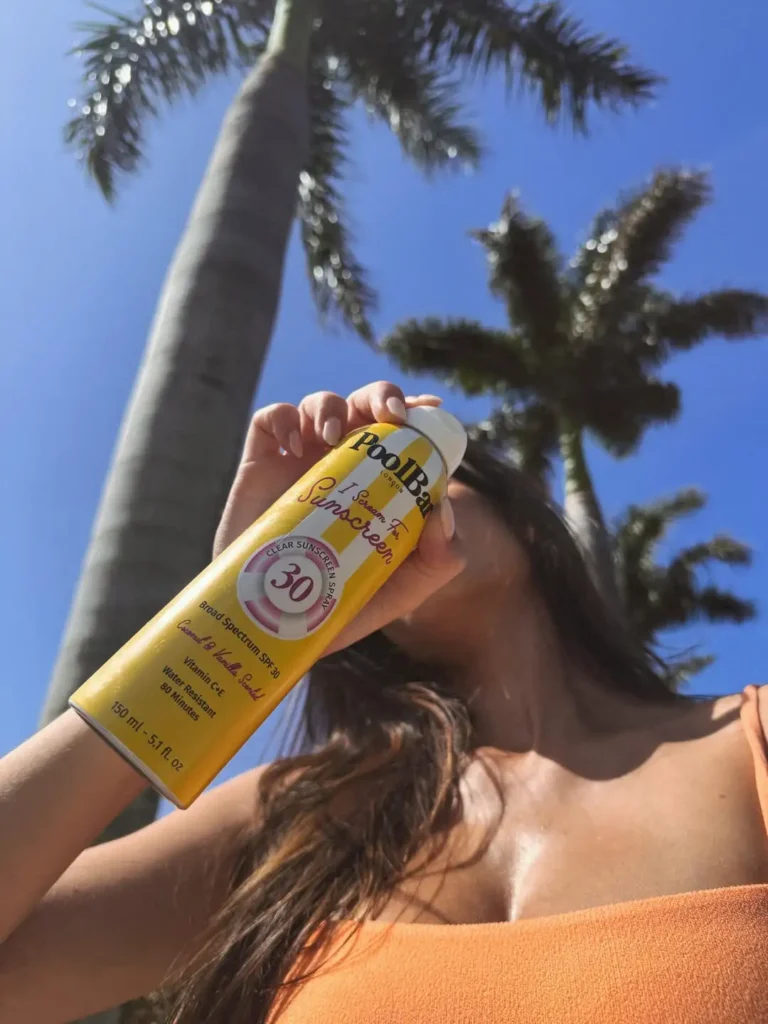
Prefer a spray? Our SPF 50 Clear Spray gives broad-spectrum protection with 80 minutes of water resistance. Just remember that sprays always need to be rubbed in to offer SPF protection, so spray onto your hands first if it’s windy and work it into your skin.
The best format is the one you’ll actually use, so pick whatever feels right for you.
The Sun Doesn't Take a Ski Holiday
So, do you need sunscreen when skiing? Without question. Snow reflects up to 80% of UV rays, altitude adds around 4 to 5% for every 1,000 feet, and cold air hides the warning signs until it’s too late.
Apply a broad-spectrum sunscreen (SPF 30 or higher) before you head out, cover the spots skiers always miss, and reapply at least every 2 hours. Whether you reach for our Face Cream, Body Cream, or Clear Spray, PoolBar makes it simple to keep your skin protected from the first chair to the last cup of cocoa.
We fell for the sun poolside in Palm Springs. On the mountain, we give it a little more respect.
Frequently Asked Questions
Do you need sunscreen when skiing?
Yes. Snow reflects up to 80% of UV rays, and UV exposure increases by around 4 to 5% for every 1,000 feet of altitude, so your skin can be exposed to more UV on the slopes than on a beach.
Can you get sunburnt skiing on a cloudy day?
Yes. Up to 90% of UV rays can pass through clouds, and snow continues to reflect them back at your skin. Wear sunscreen whenever you’re outside in daylight, whatever the weather.
What SPF should I use for skiing?
Use a broad-spectrum sunscreen with SPF 30 or higher on exposed skin. On high-altitude, bright, or spring skiing days, SPF 50 on your face is recommended.
How often should you reapply sunscreen when skiing?
Reapply at least every 2 hours, and sooner after heavy sweating or wiping your face. Water-resistant formulas, like PoolBar’s 80-minute water-resistant range, help your protection last through sweat and melting snow.
What is a goggle tan, and how do you avoid it?
A goggle tan happens when the skin around your goggles is exposed to UV while the skin beneath them is covered. Apply SPF right up to the edge of your goggle line and reapply throughout the day to avoid it.
Does cold weather reduce UV rays?
No. UV rays aren’t affected by temperature. Cold air simply makes it harder to feel your skin burning, which is why skiers often don’t notice sunburn until the end of the day.