Most people know sunscreen protects against UV rays. Fewer know that UV exposure triggers a second type of skin damage that sunscreen alone cannot address.
Here is what antioxidants do, why Vitamins C and E are the most well-researched pairing in sun care, and why it matters for your daily SPF routine.
What Sunscreen Does and What It Cannot Do
Sunscreen works by filtering or blocking UV radiation before it reaches the skin. It is one of the most effective tools available for preventing sun damage, but it is not a complete defense on its own.
Even the best applied sunscreen does not block 100% of UV radiation. Some always get through, particularly UVA rays.
When UV radiation reaches the skin, it triggers the production of free radicals, unstable molecules that damage skin cells, break down collagen, and accelerate visible ageing.
A 2026 study published in the Journal of Clinical and Aesthetic Dermatology confirms that approximately 80% of free radical damage is attributed to UVA and UVB exposure, and that antioxidants act after UV radiation has passed through the sunscreen filter to address damage the filter itself cannot prevent.
Source: JCAD, 2026
This is the gap antioxidants fill. They do not replace sunscreen. They address what sunscreen cannot. Knowing how UVA and UVB rays differ and how Zinc Oxide filters UV radiation gives the full picture of how both layers of protection work together.
What Are Free Radicals and Why Do They Matter?
Free radicals are unstable molecules produced when UV radiation hits the skin. They are missing an electron and attempt to stabilise themselves by taking one from nearby healthy cells. This process, called oxidative stress, damages the skin at a cellular level.
Over time, oxidative stress breaks down collagen, contributes to pigmentation, and accelerates the visible signs of ageing including fine lines and uneven skin tone.
Free radicals also continue causing damage after UV exposure ends, not just during it. Sun exposure in the morning can still be driving oxidative stress hours later.
The skin has its own natural antioxidant defence system, but UV exposure depletes it. A 2025 peer-reviewed review confirmed that antioxidants including Vitamins C and E play a pivotal role in combating the damaging effects of oxidative stress induced by UV radiation on the skin.
Source: PubMed, 2025.
Topical antioxidants replenish that defense from the outside, giving the skin more resources to neutralize free radicals before they cause lasting damage. Knowing when UV rays are at their strongest helps make sense of when that defense matters most.
What Vitamin C Does for the Skin
Vitamin C is one of the most well-researched ingredients in skincare, with a body of evidence spanning decades. It is naturally present in healthy skin but UV exposure depletes it directly, which is why topping it up through a well-formulated product matters.
Where it comes from
Vitamin C is found naturally in fruits and vegetables but the body cannot produce it on its own. In its purest form it is unstable and breaks down quickly when exposed to air, light, or heat, which makes it one of the more challenging ingredients to work with in skincare.
Most formulas use stabilised forms of Vitamin C that stay active in the product and convert to Vitamin C once applied to the skin. A 2023 review in Pharmaceutical Science and Technology confirmed that keeping Vitamin C stable in topical products without losing its effectiveness remains one of the more complex challenges in skincare formulation.
Source: Pharmaceutical Science and Technology, 2023.
Free radical neutralization
When UV rays hit the skin, they generate unstable molecules called free radicals that damage healthy skin cells.
Vitamin C neutralizes these free radicals before they can cause harm, particularly those generated by UVA rays which reach deeper into the skin.
The Linus Pauling Institute at Oregon State University confirms that topical Vitamin C reduces free radicals in UV-exposed skin and contributes to photo protection.
Source: Linus Pauling Institute, 2011
Collagen support
Vitamin C plays a direct role in how the skin produces and maintains collagen, the protein responsible for keeping skin firm.
It supports the process that builds collagen and slows the process that breaks it down. The Journal of Clinical and Aesthetic Dermatology confirmed that daily topical Vitamin C increases collagen production and reduces its breakdown, with a clinical study showing a measurable improvement in skin density after just four months of use.
Source: JCAD, 2017
Pigmentation and dark marks
Dark spots and uneven skin tone are caused by an overproduction of melanin, the pigment that gives skin its colour. Vitamin C slows that process down, helping to fade existing marks and prevent new ones from forming.
A 2023 systematic review published in the Journal of Cosmetic Dermatology confirmed that Vitamin C inhibits melanin production and prevents the free radicals that trigger pigmentation.
This makes it particularly relevant for anyone managing post-acne pigmentation that UV exposure is known to worsen.
Source: Journal of Cosmetic Dermatology, 2023.
What Vitamin E Does for the Skin
Vitamin E is one of the most abundant antioxidants found naturally in human skin. Like Vitamin C, UV exposure depletes it, which is why having it in a daily formula matters.
Where it comes from
Vitamin E is found naturally in nuts, seeds, and vegetable oils. The skin receives it naturally through the oils it produces. In skincare it most commonly appears as tocopherol or tocopheryl acetate, a more stable form that activates once applied to the skin.
The Linus Pauling Institute at Oregon State University confirms that Vitamin E is the most abundant fat-soluble antioxidant found in human skin, with UV exposure depleting those levels directly.
Source: Linus Pauling Institute, 2012
Protecting cell membranes
Because Vitamin E is fat-soluble, it works where water-soluble antioxidants cannot reach: inside the fatty membranes that surround skin cells. Free radicals generated by UV exposure target these membranes directly.
Vitamin E sits within them and intercepts that damage before it can spread. It maintains the structural integrity of cell membranes and protects the cells from UV-induced oxidative damage.
Calming UV-stressed skin
Vitamin E has well-documented anti-inflammatory properties. It helps to reduce redness and calm skin after UV exposure. Research confirmed that topical Vitamin E significantly reduces the severity of redness and skin sensitivity associated with UV exposure.
Source: IntechOpen, 2021.
UV protection
Vitamin E provides some direct UV protection on its own, but its real strength is what it does alongside Vitamin C.
Multiple clinical studies have shown that the combination increases the amount of UV required to cause sunburn and reduces UV-induced DNA damage.
Vitamin C restores Vitamin E after it has been used up, keeping the cycle of antioxidant support going beyond what either vitamin achieves alone.
Source: North Biomedical, 2026.
Why Vitamins C and E Work Better Together
Vitamins C and E are stronger together than apart and the reason is straightforward. When Vitamin E neutralises a free radical it gets used up. Vitamin C restores it so it can keep going. That cycle of protection is what makes the combination more effective than using either on its own.
A comprehensive 2024 review examining 44 studies on topical Vitamin E confirmed that the combination of Vitamins C and E produces significantly better UV protection outcomes than either vitamin used alone, with the recycling mechanism between the two well supported across the research.
Source: International Journal of Clinical and Experimental Dermatology, 2024.
A peer-reviewed study conducted at Duke University Medical Center and published in the Journal of the American Academy of Dermatology found that a topical solution combining both vitamins provided substantial UV photoprotection on top of what sunscreen delivers, working through a completely different mechanism to UV filters.
Source: Duke University Medical Center, 2008
How Does Vitamins C & E Compare?
| Vitamin C | Vitamin E | |
|---|---|---|
| Type | Water-soluble | Fat-soluble |
| Where it works | Watery environment inside skin cells | Fatty membranes surrounding skin cells |
| Primary role | Neutralizes free radicals, supports collagen, reduces pigmentation | Protects cell membranes, calms inflammation, shields against UV-induced oxidative damage |
| Found naturally in | Fruits and vegetables | Nuts, seeds, and vegetable oils |
| In skincare | Used as stabilized derivatives that activate on the skin | Used as tocopherol or tocopheryl acetate |
Why PoolBar Includes Vitamins C and E in Every Formula
Most sun care products do not contain both Vitamins C and E. The common recommendation is to layer a separate Vitamin C serum underneath your SPF in the morning, which requires an additional step and an additional product. It is easy to skip and easy to forget.
Every product in the PoolBar range includes Vitamins C and E for antioxidant free radical support alongside broad-spectrum UV protection, with no additional steps required.
Understanding how often to reapply sunscreen ensures that antioxidant support stays consistent throughout the day alongside the UV protection.
PoolBar’s Mineral SPF 50 Face Cream, Mineral SPF 50 Body Cream, and Mineral SPF 30 Body Cream combine Zinc Oxide for broad-spectrum UVA and UVB protection with Vitamins C and E for antioxidant support.
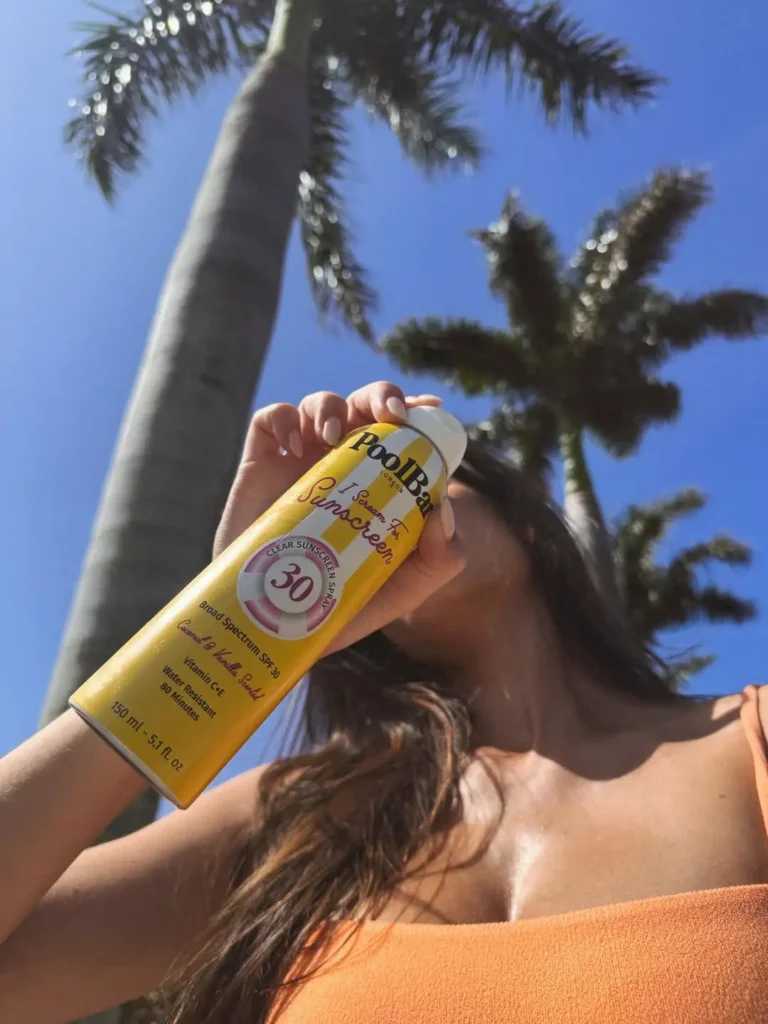
The SPF 30 Clear Spray and SPF 50 Clear Spray do the same, pairing broad-spectrum UV protection with Vitamins C and E. Every formula is dermatologically tested for all skin types, reef safe, and formulated and manufactured in the USA.
A full look at what goes into a mineral sunscreen formula shows how each ingredient earns its place.
Browse the antioxidant sunscreen range to find the right formula for your routine.
Frequently Asked Questions
Do antioxidants replace sunscreen?
No. Sunscreen and antioxidants work through completely different mechanisms and neither replaces the other. Sunscreen filters or blocks UV radiation before it reaches the skin.
Antioxidants neutralize the free radicals that are generated when UV radiation gets through, which no sunscreen can fully prevent.
The two work best used together, with sunscreen as the first line of protection and antioxidants addressing what gets past it.
When should you apply antioxidants in your skincare routine?
Antioxidants are most effective in the morning, when UV exposure and environmental stress are at their highest.
If using a separate Vitamin C serum, apply it after cleansing and before your SPF, as the last step of your skincare routine before sun exposure begins.
If your antioxidants are already built into your sunscreen formula, as they are in every PoolBar product, a separate step is not needed. For more on where SPF sits in a morning routine, When To Apply Sunscreen In Your Skincare Routine covers each step.
Do all sunscreens contain antioxidants?
No. Most sunscreens contain UV filters and little else. Vitamins C and E are not standard inclusions across the sunscreen category, which is why formulas that do include them are worth knowing about.
Every product in the PoolBar range includes Vitamins C and E for antioxidant free radical support alongside broad-spectrum UV protection, built into the formula rather than requiring a separate step.
Is Vitamin C or Vitamin E better for sun protection?
Neither is better on its own because they protect different parts of the skin cell. Vitamin C is water-soluble and neutralizes free radicals in the watery environment inside cells.
Vitamin E is fat-soluble and protects the fatty membranes surrounding them.
UV exposure generates free radicals in both areas, which is why the combination is significantly more effective than either vitamin used alone.
When Vitamin E is used up neutralizing a free radical, Vitamin C regenerates it so it can keep working. The two work best when paired together.
Sun Care Infused With Skincare
PoolBar London sunscreens are formulated and manufactured in the USA, dermatologically tested, reef safe, and Hawaii Act 104 compliant. Broad spectrum for UVA and UVB protection, with antioxidant free radical support from Vitamins C and E.